Caught in a Chain-Reaction Crash or Highway Pileup in San Antonio? Who’s at Fault and Who Pays When Several Cars Collide


In a Texas chain-reaction crash, the driver who caused the first impact is usually the first one at fault. But fault rarely stops with one driver.
Every driver who was following too closely, going too fast or not watching the road can share the blame for the impact he caused. Texas splits that blame by percentage and it’s the same in San Antonio.
The harder part is often the money. Several injured people may be claiming against one driver’s insurance policy, and Texas lets that insurer settle with whoever comes first.
Here is how fault and payment work when three or more vehicles collide on I-10, I-35, I-37, Loop 410 or US 90.
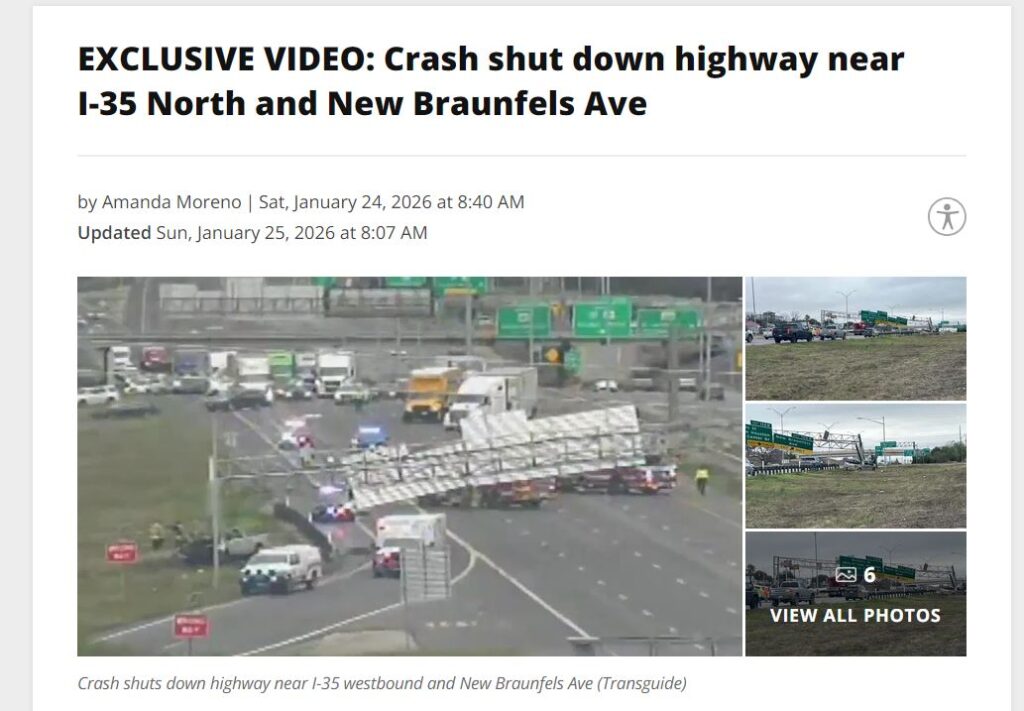
What counts as a chain-reaction crash in San Antonio?
Any crash involving three or more vehicles where one impact sets off the next. In a push crash, a car is shoved into the one ahead of it. In a pileup, drivers keep arriving and hitting the wreck in separate impacts.
The Federal Highway Administration also tracks secondary crashes. Those are crashes that happen at the scene of an earlier crash, or in the line of traffic backed up behind it, in either direction.
These crashes happen on San Antonio highways all year. A few from 2026:
- In February, two trucks collided on I-10 between Camp Bullis Road and Boerne Stage Road. As they tried to move off the highway, a third truck crashed into them, and a man died. Our page on I-10 truck crash injuries covers that corridor.
- In June, dashcam video caught several cars colliding on Northwest Loop 410 near Military Drive just before 3 a.m.
- In September, six vehicles crashed on Highway 90 West near the Highway 151 ramp after a driver swerved when traffic suddenly stopped. Three drivers went to the hospital with life-threatening injuries.
Bexar County recorded 46,744 crashes in 2025, with 190 deaths and 759 suspected serious injuries, according to TxDOT’s 2025 county crash report.
For the rest of a crash claim, from medical bills to settlement, see our page for a San Antonio car accident lawyer.
Who is at fault in a chain-reaction crash?
Each driver answers for the impact he caused. In a simple push crash, that often means the last driver caused every impact in the chain. In a pileup with separate impacts, fault is sorted out one impact at a time.
In Texas, rear-ending someone does not make a driver liable on its own. You still have to show what that driver did wrong, such as following too closely, speeding or looking at a phone.
| Your place in the chain | Who is usually at fault | What can change that |
| Front car, hit once from behind | The driver behind you, or whoever pushed that car into you | You stopped suddenly for no reason or cut in too close |
| Middle car, hit from behind and pushed forward | The driver who hit you, for both of your impacts | You hit the car ahead before you were hit |
| Middle car that hit first, then got hit | You may share fault for the front impact; the driver behind you answers for the rear | Your speed and following distance at the time |
| Last car in the chain | Usually the last driver | A car cut in front of that driver or stopped without reason |
A loaded 18-wheeler needs far more room to stop than a car. When one is at the back of the chain, the trucking company’s own rules and records come into play, as our page on 18-wheeler crash claims explains.
Sudden stops at highway lane closures raise their own fault questions, covered on our work zone crash claims page.
Were you pushed into the car ahead, or did you hit it first?
That question decides whether you share fault for your front impact, and insurers fight over it. If you stopped in time and were shoved forward, the driver behind you is usually responsible for both impacts.
The answer is in the damage pattern, the airbag data and the timing of the impacts. That is why the cars themselves need to be inspected before they are repaired or scrapped.
Can the driver in front share the blame?
Yes. Texas courts have held that a lead driver owes the drivers behind him ordinary care, too.
Brake-checking, stopping in a travel lane for no reason, or cutting in and then braking hard can put part of the fault on the car in front.
Who pays when one driver’s insurance can’t cover everyone?
The at-fault driver’s liability insurance pays first. In a pileup, though, that one policy may have to cover everyone the driver hurt, and Texas only requires $30,000 per person and $60,000 per crash for injuries.
That $60,000 can disappear fast when four or five people are hurt. Texas does not require the insurer to split it evenly.
In Texas Farmers Insurance Co. v. Soriano (Tex. 1994), the Supreme Court of Texas looked at several claims against one policy that was too small for all of them. It held that the insurer may make a reasonable settlement with one claimant, even if that uses up or shrinks what is left for the others. If you wait, the policy may already be spent.
Other policies can be in play, too. A company truck, a delivery van or a rideshare accident in the chain can each bring a larger commercial policy.
Shaw Cowart, LLP, where Ethan L. Shaw, Of Counsel to JRE Injury Law, is a partner, obtained a policy-limits settlement of more than $350,000 in Oropeza v. Taylor for a family, including three children, injured in a collision.

What can your own insurance cover after a pileup?
Your own policy may fill the gap the at-fault driver leaves. Underinsured motorist (UIM) coverage pays when the at-fault driver’s limits are too low for your losses. Personal injury protection (PIP) pays medical bills and lost wages no matter who was at fault.
Texas insurers have to offer both, so you have them unless you turned them down in writing. Your own insurer can still fight a UIM claim the way any other insurer would.
Shaw Cowart, LLP obtained a jury verdict of more than $2 million in Telfort & Nunez v. State Farm Mutual Automobile Insurance Co., an underinsured-motorist claim.
You can review more of our attorneys’ results.
What if the car that started it drove away?
Your uninsured motorist (UM) coverage can step in, but Texas adds a condition. When the driver is unknown, there must have been actual physical contact between that driver’s vehicle and you or your vehicle (Tex. Ins. Code § 1952.104).
Texas courts apply that rule strictly. In Nationwide Insurance Co. v. Elchehimi (Tex. 2008), a wheel assembly that broke off an unidentified truck and struck a car did not count.
Some Texas courts have accepted indirect contact through a chain of impacts, where the unknown car hit another vehicle that was then pushed into yours. Whether that works depends on the facts, so witness statements and the crash report matter.
How do insurance companies split fault in a pileup?
Each insurer tries to push fault toward the other drivers, because every percentage point it shifts away lowers what its own driver pays. With four or five insurers in one crash, you can end up as the target of all of them.
Expect calls from several adjusters in the first few days, each asking where your car was and when you braked. Under Tex. Civ. Prac. & Rem. Code § 33.001, any share of fault pinned on you cuts your recovery, and above 50% you recover nothing.
What evidence shows the order of impacts?
The evidence that shows which car hit which, in what order and at what speed. Much of it sits in other people’s cars and phones.
- The CR-3 crash report, from the TxDOT Crash Report Online Purchase System, with the officer’s diagram numbering each vehicle
- Event data recorders, the “black boxes” that can record each car’s speed, braking and steering just before the crash
- Dashcam and phone video from drivers and people who stopped
- Photos of front and rear damage on every vehicle in the chain
- A truck’s engine data and camera footage, if a commercial truck was involved
- 911 call times and witness statements, which help fix the order of impacts
Under Tex. Transp. Code § 547.615, data from another driver’s recorder generally can be pulled only with the owner’s consent or a court order. That is why we send preservation letters early, before a car is repaired, sold or scrapped.
Can drivers be blamed for a second crash at the scene?
Yes. A driver who plows into an earlier crash answers for his own impact, and sometimes the drivers from the first crash share the blame for how the scene was left.
After a freeway crash in a metropolitan area that damages only vehicles, drivers whose cars can still be driven safely must move them out of the main lanes (Tex. Transp. Code § 550.022).
Drivers coming up on a stopped emergency vehicle, tow truck or TxDOT vehicle with its lights on must move over a lane or slow to 20 mph below the limit (Tex. Transp. Code § 545.157). Those rules matter because the people near the first crash, or still sitting in it, are exposed to every car that comes next.
How long do you have to file after a pileup?
Two years from the crash in most Texas injury cases, under Tex. Civ. Prac. & Rem. Code § 16.003. In a pileup, though, the practical deadline is often much sooner.
The at-fault driver’s policy can be used up by other claimants long before two years pass. And if a city or state vehicle was in the chain, the notice deadline is measured in months, not years.
If someone died, the family’s wrongful death case in Texas has its own two-year clock, starting on the date of death.
Hurt in a San Antonio Pileup? Call Before the Insurance Money Runs Out
The sooner we start, the more of the at-fault driver’s policy may still be there, and the more evidence is still in the cars.
Mr. Echavarria, a former Bexar County prosecutor, has recovered tens of millions of dollars for injured clients. His trial team includes Of Counsel lawyers such as Mr. Shaw, who is Board Certified in Personal Injury Trial Law and Civil Trial Law by the Texas Board of Legal Specialization.
Past results do not guarantee or predict a similar outcome. Every case is different and depends on its own facts.
Call (210) 272-0101 or toll-free (844) 702-0350, 24/7, or reach us through our online contact form. Your case review is free, in English or Spanish. You Pay Nothing Unless You Win.
Para leer en español, visite nuestra página de abogados de accidentes de carro.