
Need a Car Accident Attorney in Downtown San Antonio? What to Know.


If you were hurt in a car accident in downtown San Antonio, talking to an attorney early can protect deadlines most people never hear about.
Downtown crashes often involve a city street, a TxDOT highway deck, a VIA bus or an out-of-town driver. Each one changes who pays and how fast you have to act.
The tightest deadline belongs to the City of San Antonio. If a city vehicle or a city traffic signal played a part, the City must receive written notice within 90 days.
Here is what makes a downtown crash claim different, and what to do about it.
Why is a downtown San Antonio car accident claim different?
Because downtown packs more kinds of drivers and road owners into a few square miles than anywhere else in the city. Who caused the crash, and who owns the vehicle or the road, decides the deadline and how much can be recovered.
| What happened downtown | Who may be responsible | Deadline to act |
| Another driver hit you on a downtown street | That driver and his insurer | Two years to file suit (Tex. Civ. Prac. & Rem. Code § 16.003) |
| A city vehicle hit you, or a city signal was dark or broken | The City of San Antonio | Written notice the City receives within 90 days (City Charter § 150) |
| A VIA bus hit you | VIA Metropolitan Transit | Notice within six months; damages capped at $100,000 per person |
| A tourist in a rental car hit you | The driver, through his own policy or coverage bought at the counter | Two years to file suit |
| The other driver had been drinking at a downtown bar | The driver, and possibly the bar | Two years to file suit |
The rest of a car accident claim, from medical bills to settlement, is covered on our page for a San Antonio car accident attorney.
Where are drivers most at risk in downtown San Antonio right now?
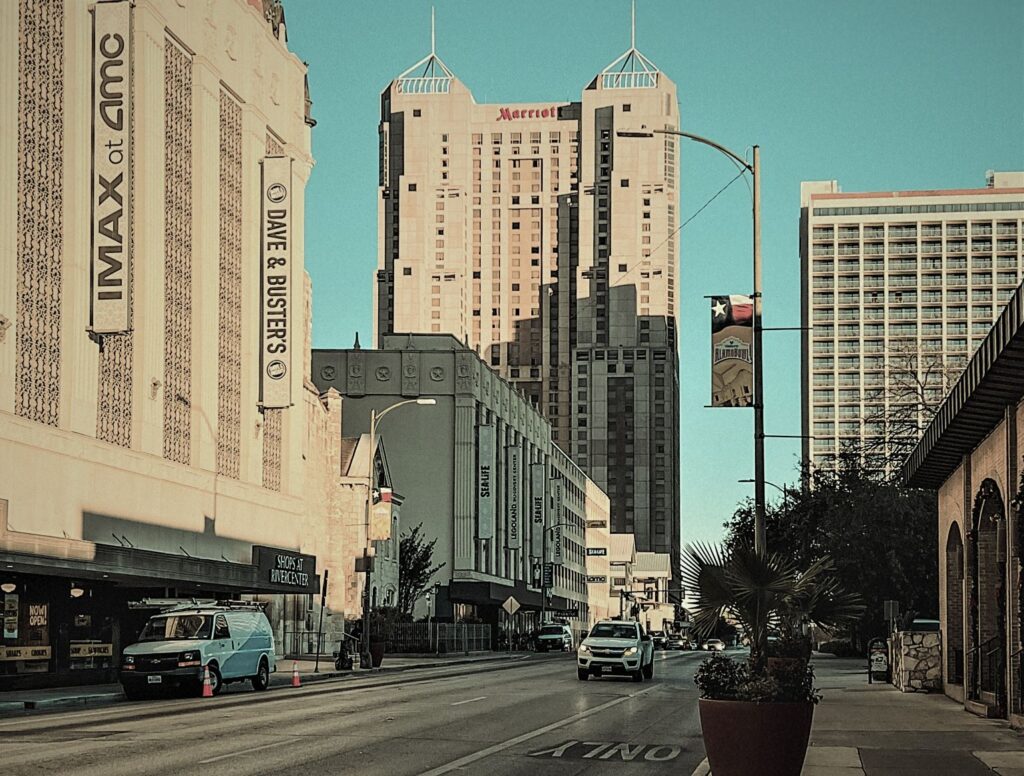
No official study ranks downtown streets by crash count. But four things drive much of the risk downtown in 2026: the stacked highway decks, VIA’s Green Line construction, the closures around the Alamo, and the crowds that come with big events.
Why are the downtown highway decks so dangerous?
I-10, I-35 and I-37 wrap around downtown on stacked upper and lower levels, with tight curves such as the Finesilver Curve. TxDOT has been running a $25.9 million, 5.5-mile I-35 and I-10 downtown repair project, with lane and deck closures into 2026.
Those closures move traffic into unfamiliar lanes, at times with a single lane open on an upper deck.
In June 2026, a wrong-way driver crashed head-on into another vehicle on the upper level of southbound I-35 near the Finesilver Curve at about 2:30 a.m., and both drivers died. If you lost a family member in a crash like that, our page on wrongful death claims explains who can file.
How is VIA’s Green Line construction changing downtown streets?
VIA is building the $481 million Green Line, a 10-mile rapid bus route through downtown with dedicated bus lanes on parts of St. Mary’s Street and San Pedro Avenue. It will give buses signal priority at 58 intersections, and VIA’s target for finishing it is April 2028.
Until then, expect lane closures and shifts on streets such as Navarro and St. Mary’s. A crash caused by a confusing lane shift can bring the construction contractor into the claim, as our page on construction lane shift crashes explains.
What changed around the Alamo?
Alamo Street in front of the Alamo Church has been closed to cars since May 2021. The Alamo Plan also calls for closing parts of Houston, Alamo and Crockett streets as the area becomes a pedestrian district.
For drivers, that means detours, dead ends and more people on foot crossing between the Alamo, the River Walk and nearby hotels.
How do tourists and events add to the risk?
San Antonio drew 40.2 million visitors in 2025, according to Visit San Antonio. Many of them drive rental cars on a downtown grid of one-way streets they have never seen before.
Fiesta parades close Houston Street, Alamo Plaza and Commerce Street, and KSAT reported more than 350,000 spectators at the 2026 Battle of Flowers Parade. Horse-drawn carriages also still share downtown streets; the City Council voted in 2024 to ban them from the city center starting Jan. 1, 2030.
Rideshare drivers stopping for pickups and riders on rental scooters add to the mix. We cover Uber and Lyft crashes and e-scooter injuries on their own pages.
What if a city vehicle, a dark signal or a VIA bus was involved?
Then you are dealing with a government, and the deadlines are short and strict. For the City of San Antonio, written notice has to reach the City Manager or the City Clerk within 90 days of the injury, under City Charter § 150.
Courts measure that deadline by when the City receives the notice, not when it was sent (City of San Antonio v. Rocha). A missed deadline can be waived only by a City Council resolution adopted within those 90 days (Dias v. City of San Antonio).
The City takes claims through its online notice of claim form. The notice must say when, where and how the injury happened and how serious it is, so it pays to get it right the first time.
A dark or broken traffic signal creates a claim against the City only if the problem was not fixed within a reasonable time after the City was notified (Tex. Civ. Prac. & Rem. Code § 101.060).
VIA is a governmental unit, too. A claim against VIA needs notice within six months, and its damages are capped at $100,000 per person and $300,000 per occurrence, compared with $250,000 per person for the City.
What if a tourist in a rental car hit you?
You usually claim against the driver’s insurance, not the rental company. Under the federal Graves Amendment (49 U.S.C. § 30106), a rental company generally is not liable just because it owns the car. The exception is when the company itself was negligent, such as by renting out a car with bad brakes.
The money usually comes from the renter’s own auto policy, any liability coverage bought at the rental counter, and, if those fall short, your own underinsured motorist coverage. A driver who lives in another state can still be sued in Bexar County, where the crash happened.
Get the renter’s name, home address, license and rental agreement number at the scene. Out-of-town drivers are often gone within days.
Can a downtown bar be held responsible for a drunk driver?
Sometimes. Under the Texas Dram Shop Act (Tex. Alco. Bev. Code § 2.02), a bar can be liable if it served a customer who was obviously intoxicated to the point of being a clear danger. The intoxication must also have caused your crash.
That is a hard standard to meet. In Raoger Corp. v. Myers (Tex. 2025), the Supreme Court of Texas ruled for a restaurant. The injured driver’s evidence rested mostly on the drunk driver’s later blood-alcohol level and estimates of how much he had to drink, and it did not show his intoxication was apparent to staff when he was served.
What helps is proof of what the staff could see: tabs and receipts, security video, and people who watched the driver at the bar. Video is often recorded over, so we move to preserve it quickly.
Shaw Cowart, LLP, where Ethan L. Shaw, Of Counsel to JRE Injury Law, is a partner, obtained a settlement of more than $750,000 in a dram shop claim against a hotel bar. Past results do not guarantee or predict a similar outcome. Every case is different and depends on its own facts.
You can see other case results from our team.
What should you write down before you leave a downtown crash scene?
The details that disappear first: where the lanes and cones were, what the signal showed, and who the other driver really is. SAPD usually investigates crashes on downtown streets, but the officer’s report won’t capture everything.
- Photos of the lane setup, signals, cones and construction signs, since downtown lanes can change from week to week
- The other driver’s name, address, insurer and plate, plus the rental agreement if it was a rental car
- The bus or unit number if a VIA bus or city vehicle was involved
- Where the other driver says he had been, if there are signs he had been drinking
- Witnesses’ names and phone numbers, including hotel, valet or parking staff
- The SAPD case number, so you can later buy the CR-3 crash report from the TxDOT Crash Report Online Purchase System
Get checked by a doctor the same day, even if you feel fine.
Why work with JRE Injury Law after a downtown crash?
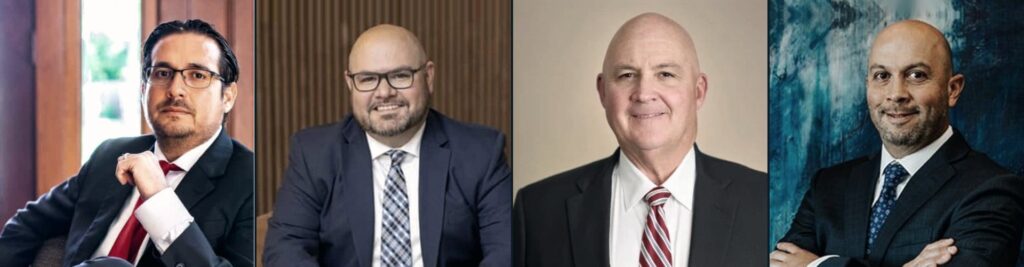
Mr. Echavarria is a former Bexar County prosecutor who worked in the criminal courts at the Cadena-Reeves Justice Center on Dolorosa Street. He has recovered tens of millions of dollars for injured clients.
Most Bexar County injury cases are heard a short walk away, in the civil district courts at the Bexar County Courthouse, 100 Dolorosa. Mr. Shaw is Board Certified in Personal Injury Trial Law and Civil Trial Law by the Texas Board of Legal Specialization.
His jury verdict of about $70 million in Tate v. Discover Property & Casualty came out of the 225th District Court, one of those civil courts. He tried the case with co-counsel Tom Rhodes against an insurer that wrongfully denied an injured worker’s benefits.
Past results do not guarantee or predict a similar outcome. Every case is different and depends on its own facts.
Call (210) 272-0101 or toll-free (844) 702-0350, 24/7, or send us a message through our online contact form. The first consultation is free, in English or Spanish. You Pay Nothing Unless You Win.
Para leer en español, visite nuestra página de abogados de lesiones personales.